Back in the olden days, when ships were still wooden and the wind was fuel, the ports and harbors along Maine’s coast were hubs of financial activity and doorways to the world. Casco Bay led the state’s maritime activity with respect to shipping volume and economic impact, so it may be easy to understand how certain legends were born in a region death visited often. The life of a sailor was daunting enough, but during the years of 1812 thru 1815 (the War of 1812) it was as risky as it was lucrative. For entire family lines, beginning before the founding of our burgeoning nation straight through the War of 1812, and beyond, men have taken to the open ocean in spite of the gamble that they may not return. The opportunities for ‘payoff’ were just too good to pass up. The maritime shipping industry during the War of 1812 was a total vibe, and it reflected the enthusiasm and ambitious nature of the entire region. Shoreline to farmland, everyone depended on the shipping trade in some way or another.
The legend of Casco Bay’s Fleet of the Dead, or ‘Ghost Fleet’ as locals came to call it, went viral in 1866 with the help of John Greenleaf Whittier’s poem “The Dead Ship of Harpswell”. Although the poem never mentions a name for “The Dead Ship” directly, it was quickly assumed by locals “in the know” to mean either the Dash or the Sarah. Both had gone missing during the War of 1812 and both had disappeared under equally traumatic circumstances. One school of thought purports that haunted environments have spirit activity because the people who died there did so in such an intense emotional state they left behind the energy they last had before they passed, marking the environment, so to speak. The conditions of the Dash, which sailed into Georges Bank in the blinding snow gales of a winter Nor’easter and smashed to pieces with all 60 hands on board, and the Sarah, whose innocent crew was slaughtered because of a beef a pirate had with their captain, would certainly fit that narrative.
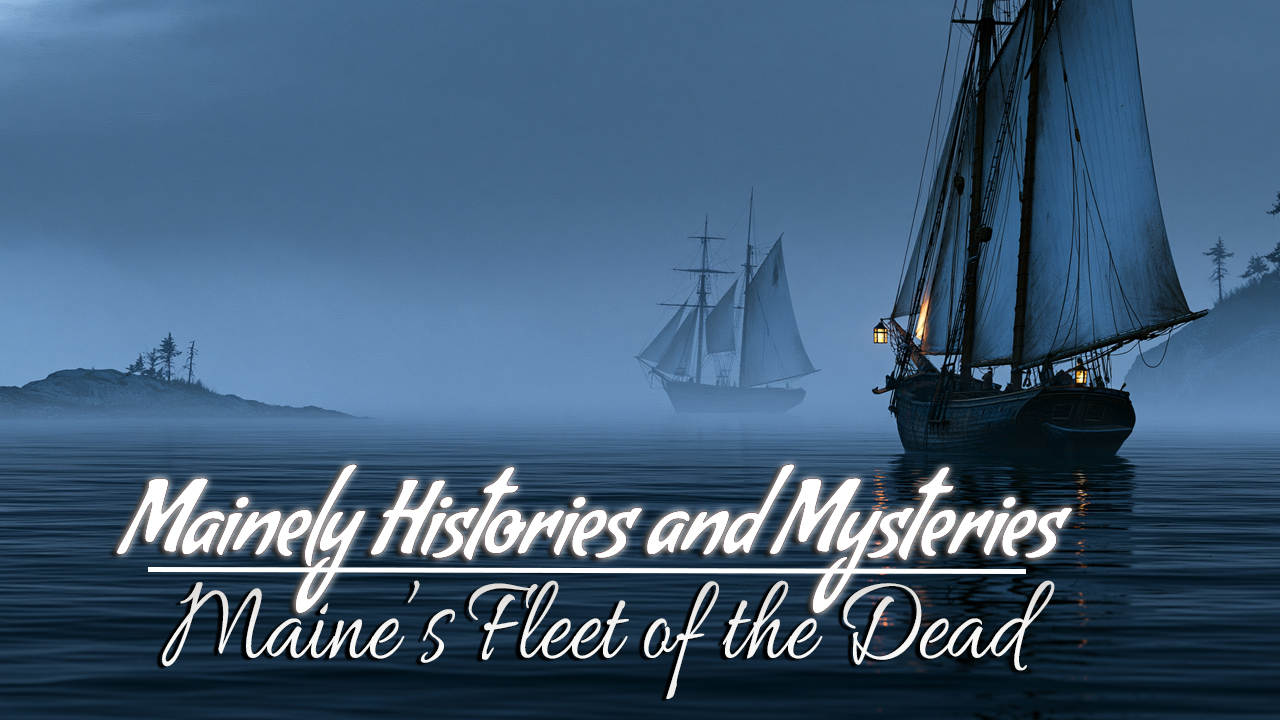
Local fishermen began seeing the ghost ship Dash very soon after her disappearance in 1815. So soon, in fact, it was initially surmised she was returning home from whatever harrowing ordeal had kept her at sea and away from her home port for so long. The Sarah’s story is even more intriguing because she was last seen in physical form drifting motionless at Potts Harbor back in 1813 after it had gone missing while on its maiden voyage. She was piloted home with expert grace through the challenging waters of Casco Bay and into Harpswell, where her spectral crew disembarked their unconscious – but still clinging to life – captain on a grassy patch at an outer edge of Potts Point. The ghostly crew then turned the ship back toward the fog bank that had rolled in behind her, and slowly vanished into it, before onlookers realized what they were actually witnessing.
The title of the legend, “Fleet of the Dead” or “Ghost Fleet” suggests that observers are likely to see numerous ghost ships sailing together for some common reason. Maybe they appear as one unit sailing toward the same direction, or maybe they appear all at the same time but are clearly adversarial. Whatever theories may arise by way of drawing inferences from the title would likely be incorrect. The “Fleet of the Dead” is a legend that was born and raised in mid-coast Maine by maritime communities who felt the deepest sense of loss for their crewmember-kin who never made it back home. It refers only to the 2 wooden ships, the Dash and the Sarah, who were both built in 1813 in Freeport, Maine but had little, to nothing, to do with each other. I have yet to encounter a documented sighting of both ships appearing at the same time, and the last somewhat verifiable witness account of the Sarah happened well over 130 years ago. In complete contrast, the Dash has been sighted fairly regularly off the coast of Harpswell and Freeport right up until recently – as in, within the past couple of years (as of 2025). We’re talking full-on direct observation of a topsail schooner floating, even swiftly gliding, silently as if it’s supposed to be there; the word “Dash” and sometimes “Dash – Freeport” seen clearly and boldly on the prow.
Though the Sarah appears to have sailed into the great beyond, the Dash returns as an occasional reminder to unexpected observers in Casco Bay that her legacy lives on and her crew still longs for safe harbor and familiar shores.
If you’ve had an experience where you’ve seen the Dash or the Sarah tell us your story in the comments so our readers can relish in your ghost ship sighting! If the comments aren’t working (sometimes we have to turn the off due to spam bots) email us direct. We’d be stoked to hear from you.
Bibliography
- “A legendary Freeport-made ship haunts Harpswell waters.” Portland Press Herald, June 10, 2025.
- “The Ghost Ship of Casco Bay.” Casco Bay Lines, October 30, 2018.
- “The haunted history of the ghost ship Dash.” Big Think, October 2, 2025.
- “The Dead Ship of Harpswell – Eerie News.” Marlene Pardo Pellicer Substack, July 20, 2024.
- “Legend Says A Phantom Ship Lurks Off The Coast Of Harpswell.” Q106.5 FM, October 20, 2022.
- “Maine’s Ship from the Fleet of the Dead.” What Lies Beyond, August 24, 2014.
- “Podcast 331 – The Dead Ship of Harpswell – New England Legends.” Our New England Legends, December 31, 2023.
- “The Sarah Soule.” Seeks Ghosts Blogspot, February 15, 2014.
- “The ghost ship of Harpswell.” Sam Smith’s Essays, WordPress.com, September 9, 2012.
- “Harpswell Ghost Ship.” Celebrate Boston, December 31, 2019.
- “Visiting Ghosts on Birch Island.” Harpswell Heritage Land Trust, August 20, 2016.
- “Casco Bay Under Military Rule.” Fishermen’s Voice, December 31, 2015.
- “Bear Island, Northeast Harbor, 1855—Fitz Henry Lane Online.” Fitz Henry Lane Online, March 13, 2017.
- “Book Collections at the Maine State Library.” Digital Maine, February 4, 2020.